Guide · Wisdom teeth
Wisdom teeth: when do they need removing?
Less often than people think — and more often than people would like. Here’s how a dentist actually decides, what the two kinds of extraction involve, and what recovery and cost look like in Edinburgh.
Why wisdom teeth cause trouble
They are the last teeth to come through, usually between the late teens and mid-twenties, and by then there is often no room. A tooth that only partly erupts leaves a flap of gum that traps food and bacteria (the cause of the classic on-and-off wisdom-tooth ache), one that comes through at an angle can press on the tooth in front, and one that can’t be cleaned decays — or lets the neighbour decay.
When removal is the sensible option
- Repeated infection or pain of the gum over a partly-erupted tooth
- Decay in the wisdom tooth, or in the tooth in front of it, because the area can’t be cleaned
- An impacted tooth pressing on and damaging the neighbouring tooth
- A cyst or other change around the tooth seen on an X-ray
- A tooth in the way of planned orthodontic or other treatment
When it can be left alone
A wisdom tooth that has come through fully, sits in a reasonable position, can be kept clean and isn’t causing symptoms is usually left where it is. Removing healthy teeth “just in case” isn’t recommended in the UK, because extraction carries its own small risks. A good dentist will tell you which category yours is in — and it’s a decision made from an X-ray, not a guess.
The X-rays that decide it
An OPG (panoramic X-ray) shows where the tooth sits, which way it’s pointing and the shape of its roots. Where the roots of a lower wisdom tooth sit close to the nerve that runs through the jaw, a CBCT 3D scan shows how close, which helps the dentist judge the risk with you; it doesn’t remove it. City Dental Care has both in-house — see our guide CBCT vs OPG.
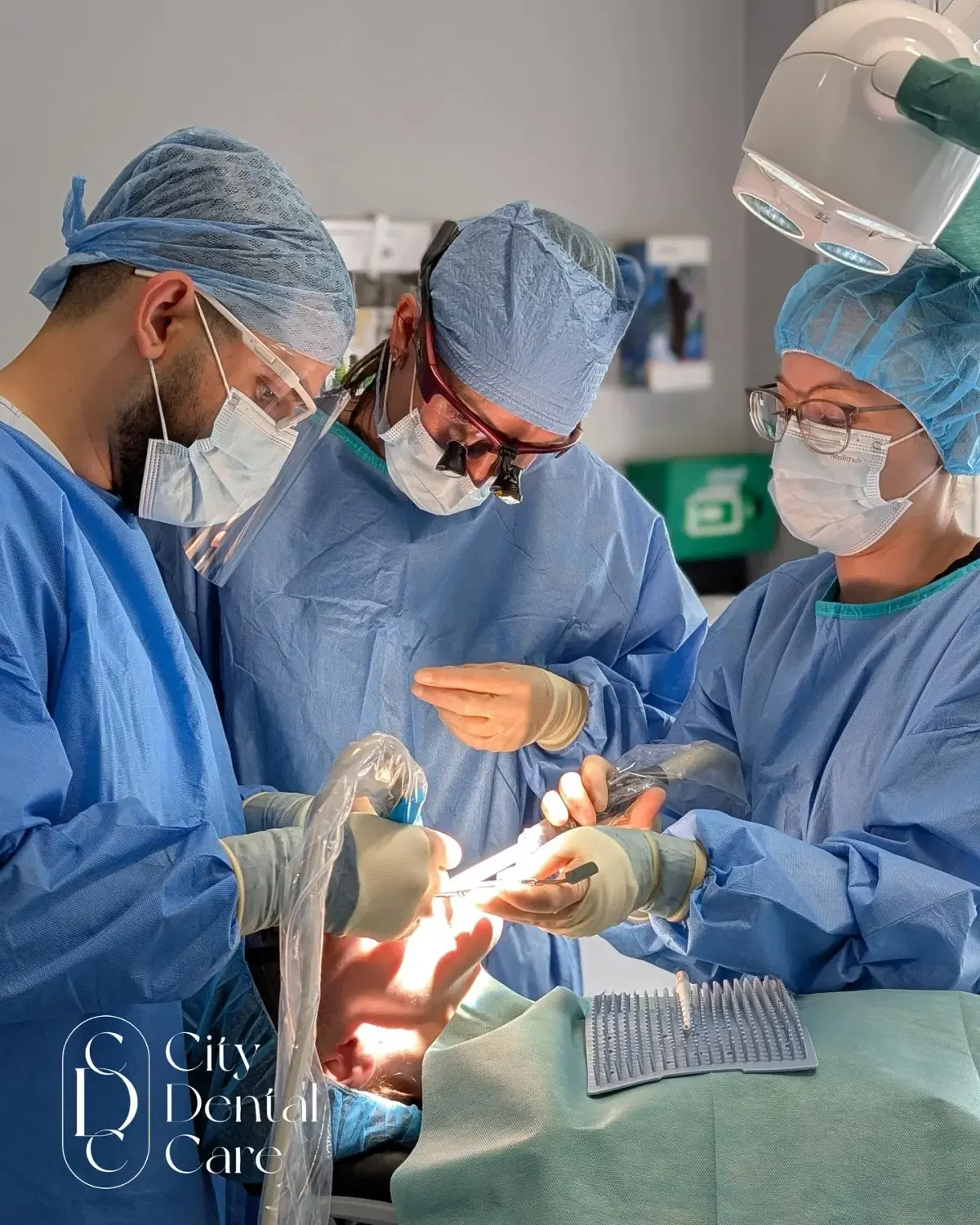
Simple vs surgical extraction
| Simple extraction | Surgical extraction | |
|---|---|---|
| When | Tooth has come through and can be gripped | Tooth is under the gum or bone, or angled |
| What happens | Numbed, loosened and removed in one piece | Numbed, small incision in the gum, sometimes a little bone removed or the tooth sectioned, stitches |
| Recovery | A few sore days | Sorer for longer; swelling common; a week or two |
| At City Dental Care | from £110 | from £350 |
Both are done under local anaesthetic — you feel pressure and movement, not pain. The X-ray tells the dentist which kind yours is before it’s booked, so the price is confirmed in advance.
Recovery, honestly
- Days 1–3: the sorest; some swelling and stiffness is normal. Ordinary painkillers, soft food, no rinsing or smoking on day one (it dislodges the clot).
- Days 3–7: improving daily. Gentle warm salt-water rinses from day two keep the socket clean. Stitches, if used, usually dissolve.
- Week 2: most people are back to normal. Surgical extractions can take a little longer.
- Watch for: pain that gets worse after day three (possible dry socket — call, it’s easily treated), spreading swelling, or numbness that doesn’t wear off.
Wisdom tooth bothering you?
An assessment with an OPG X-ray — in-house — tells you whether it needs to come out, which kind of extraction it would be, and the price in writing. Evenings until 8pm, Monday to Thursday (we close at 5pm on Friday).