Opening Time
Mon–Thu 8.30am–8pm | Fri 8.30am–5pm
Mon–Thu 8.30am–8pm | Fri 8.30am–5pm
Phone
0131 228 2442
0131 228 2442
WhatsApp
07352 038861
07352 038861
Location
9 Earl Grey Street, Edinburgh
9 Earl Grey Street, Edinburgh
A fixed, long-term answer to missing teeth — planned at City Dental Care on Earl Grey Street.
A single implant with its crown costs from £1,495, plus £149 for the CBCT scan and implant planning, unless you already have a suitable recent CBCT taken elsewhere that we can use. More complex cases are quoted in writing at the end of your consultation.
An implant consultation answers three questions: is an implant suitable for you, what would it involve, and what would it cost, in writing. Where imaging is needed, a CBCT scan is taken in-house the same visit to measure the bone and locate nerves and sinuses, so there is no second trip elsewhere before you get an answer.
The initial implant consultation is free. The free implant consultation does not include the CBCT scan and implant planning, which is £149 when a new scan is needed. We take a deposit when you book, under our Failure to Attend policy, and it is refunded when you attend; we confirm the amount when you book. A free consultation is an initial consultation, not a full dental examination.
You leave with a written, itemised plan setting out stages, timeline and price, with finance options, before anything is done and with no obligation to go ahead. If the answer is “not yet” — because of bone, gum health or healing — we'll explain what would need to change first.
Evening appointments until 8pm, Monday to Thursday (we close at 5pm on Friday).
A dental implant is a small titanium post placed in the jaw to act as an artificial tooth root, with a crown, bridge or denture fixed on top. Your written plan says which of the following stages apply to you.
Any preparatory work comes first. Implants succeed in healthy mouths, so if gum disease, decay or insufficient bone would compromise the result, that is addressed before surgery, sometimes with a bone graft where the jaw has receded. Not everyone needs this stage.
The implant is then placed under local anaesthetic, so the area is numb. Most patients describe pressure rather than pain and find the days afterwards more comfortable than they expected, with ordinary pain relief; some soreness and swelling in the first days is normal. You leave with clear aftercare instructions and a direct line to the practice if anything concerns you.
Over the following months the bone grows onto the implant surface and locks it in place, the process that makes an implant feel like your own tooth. Commonly the journey takes three to six months from placement to the final tooth, because the implant needs time to integrate with the bone; bone grafting, where needed, adds to that, and your plan gives timings for your case rather than an internet average. If a visible tooth is involved, a temporary solution is part of the plan so you are not left with a gap.
Once the implant is solid, the final crown, bridge or denture, made to match your natural teeth, is fixed on top. Our guide to what happens during dental implant treatment walks through each stage in more detail, and a real patient's two-part implant journey is in the videos on this page.
A single dental implant, including the crown on top, costs from £1,495 at City Dental Care. A CBCT scan with implant planning is £149 on top, unless you already have a suitable recent CBCT taken elsewhere that we can use. That is where a straightforward single tooth starts, and the written plan you receive after your consultation confirms the exact cost for your case.
Cases that need more cost more — several teeth, bone grafting where bone has receded, or a bridge or denture on implants — and each is quoted in writing at the end of your consultation. Our guide to what dental implants cost in Edinburgh takes each factor that moves the price in turn, and explains how to judge one quote against another.
To spread the cost: 0% finance is available on private treatment from £250 up to £5,000. If approved, the finance provider pays the practice directly, and you repay the provider by monthly Direct Debit over 6, 9, 10, 11 or 12 months. Plans over £5,000 can be part-financed. Discuss the options at your consultation.
In most cases dental implants are a private treatment. NHS provision exists only in a small number of specific clinical situations, usually through a hospital referral. We say at consultation which applies to you, and in Scotland you are entitled to mix NHS and private dentistry in a hybrid treatment plan.
Losing a tooth changes how you chew, how neighbouring teeth behave and, over time, even the bone in your jaw. Each way of replacing it has honest strengths and trade-offs.
Implants are the closest thing dentistry has to a natural tooth: fixed in place, they let you eat normally and, unlike a bridge, do not rely on grinding down healthy neighbouring teeth. Because the root is replaced, they also help preserve the jawbone. The trade-offs are that treatment involves minor surgery, takes place over months rather than weeks, needs healthy gums and adequate bone to succeed, and is the larger investment of the three.
A bridge anchors a false tooth to the teeth either side. It is fixed, typically completed in weeks and involves no surgery, but the anchor teeth usually need to be reshaped to carry it, and the bone under the gap still recedes because the missing root is not replaced. It can be an excellent choice when the neighbouring teeth already have large fillings or crowns.
Dentures are removable replacements for one, several or all teeth: the most affordable route, with no surgery, and able to restore a full smile at once. They can move when eating, need daily cleaning out of the mouth and do not stop bone recession. For some patients, implant-retained dentures offer a middle path: a removable denture that clips onto implants for stability. Our comparison guide, implants, bridges or dentures: which is right for you?, sets out the choice without the sales pitch.
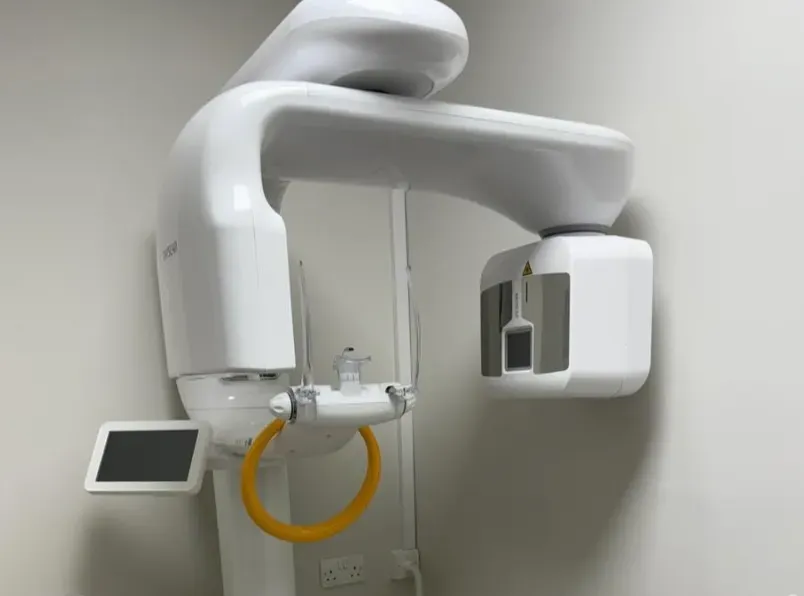
Precise implant placement relies on 3D CBCT imaging, which we provide in-house on our Rayscan Alpha 3D cone-beam CT scanner rather than referring you elsewhere. A CBCT is a 3D X-ray that shows the bone of your jaw in detail an ordinary X-ray cannot, viewed in slices from any angle: the depth and width of bone and where the nerves and sinuses sit. That is the information that decides whether an implant can be placed safely and whether grafting would be needed, so placement is planned precisely rather than estimated. Having the scanner under our own roof means implants are planned and treated in one place, without a separate trip elsewhere for a scan.
The scan itself takes a matter of seconds: you sit or stand still, having removed glasses, earrings and anything metal around the head and neck, and we ask you to tell us if you are or might be pregnant. A CBCT uses more radiation than a small dental X-ray and considerably less than a hospital CT scan, so every scan needs a clinical reason from a dentist and we use only the smallest field of view that answers the question. Our CBCT and OPG scans page explains the imaging in more detail.
Implant consultations and surgery at City Dental Care are led by Dr. Vikas Sharda (GDC 209880), BDS 2011, University of Glasgow, with postgraduate certificate and diploma qualifications in implant dentistry, who has placed over 1,000 dental implants. Meet him and the rest of the team on our team page. We also accept implant referrals from other practices, and discharge patients back to their own dentist when treatment is complete.
After the final tooth is fitted, it is brushing, interdental cleaning and regular visits to our hygienist or dental therapist, the same as your natural teeth. Implants can last many years with good cleaning and regular maintenance, though nothing in dentistry is certain to last for life. The crown on top may need replacing sooner than the implant itself, and gum health around the implant is what matters most. Well cared for, implants are a long-term investment.
9 Earl Grey Street, EH3 9BN — on Lothian Road at Tollcross in central Edinburgh, minutes from the Exchange district, a short walk from Haymarket Station. The Princes Exchange Car Park is in our building (entry from Riego Street at the rear).
Related: what determines implant cost, dental bridges, fees and 0% finance.
Meet Vikas, who leads our implant treatment, and follow a real patient's implant journey.
Videos play when tapped.
FAQs
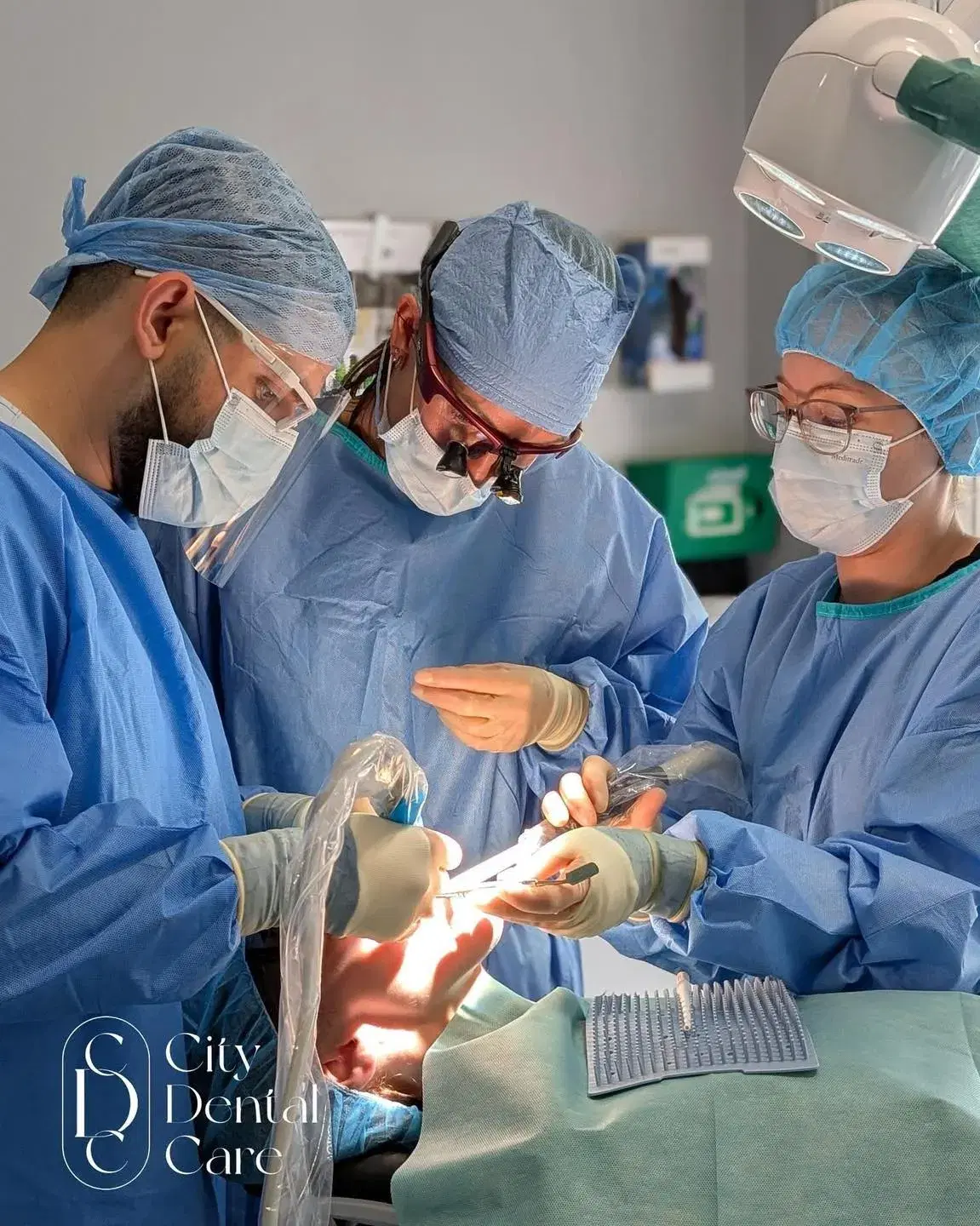

Our dental practice at 9 Earl Grey Street, Edinburgh, provides NHS and private dental care, with private treatments such as Invisalign and teeth whitening, and evening appointments until 8pm Monday to Thursday (we close at 5pm on Friday).