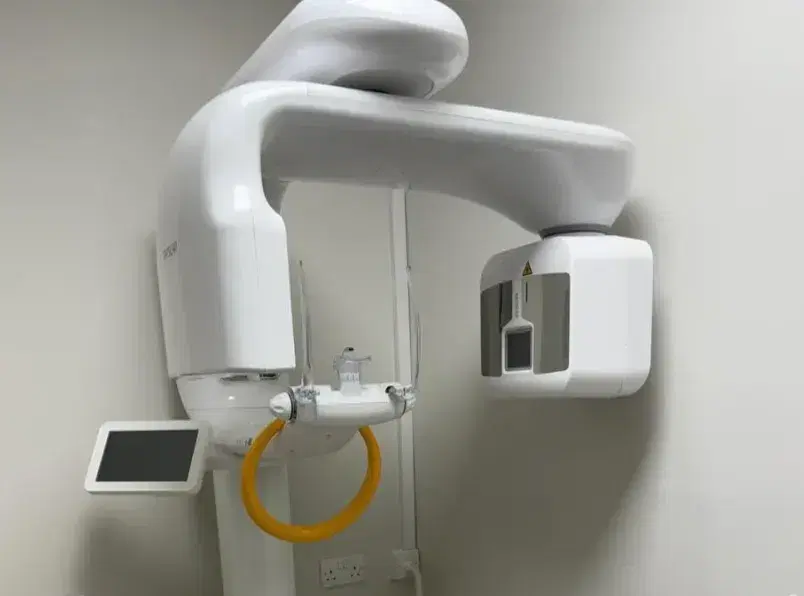
Guide · Dental imaging
CBCT vs OPG: which dental X-ray do you need?
“You’ll need a scan” usually means one of two things: an OPG, the flat panoramic X-ray of your whole mouth, or a CBCT, a 3D scan of the teeth and jaws. They answer different questions, carry different doses, and cost different amounts. Here’s how to tell which one you’re being sent for and why.
The one-minute version
| OPG (panoramic X-ray) | CBCT (cone-beam CT) | |
|---|---|---|
| What it shows | One flat image of every tooth, both jaws, the jaw joints and sinuses | The same structures in 3D, viewable in slices from any angle, with measurements |
| Typical uses | Wisdom teeth, unerupted teeth, general overview, orthodontic assessment | Implant planning, complex extractions, root canal anatomy, investigating pathology |
| Dose | Low | Higher than an OPG; much lower than a hospital CT |
| The scan itself | Seconds, standing at the machine | Seconds, sitting or standing still |
| At City Dental Care | £50 referred, imaging only | £100 referred, imaging only (single or dual arch, same price) · £149 for our own patients, including planning |
When an OPG is enough
An OPG is the workhorse overview. If a dentist wants to see where your wisdom teeth are sitting, check teeth that haven’t come through, get a whole-mouth picture before orthodontics, or look for problems a small X-ray can’t frame in one shot, an OPG usually does the job — quickly, and at the lowest dose of the two.
When a CBCT is the right call
A flat image can’t tell you how deep bone is or exactly where a nerve runs — it collapses three dimensions into two. A CBCT keeps the third dimension. That’s why it’s the standard before dental implants (measuring bone and avoiding the nerve), before difficult extractions where a root sits close to something important, in root canal treatment when the canal anatomy is unclear, and when something unusual needs a proper look.
The trade-off is dose: a CBCT uses more radiation than an OPG, though considerably less than a hospital CT. UK rules require a clinical reason for every scan, and a good practice uses the smallest field of view that answers the question — which is why nobody should be scanned “just to see”.
Why some practices send you elsewhere for a scan
CBCT scanners are expensive, so many practices — including some that place implants — don’t own one and refer you to a practice that does. That’s normal. What varies is the price and the wait: referred CBCT fees published by Edinburgh practices run from about £140 per arch to £210, and some add a separate charge for a written report.
City Dental Care has a Rayscan Alpha 3D CBCT scanner and an OPG unit in-house on Earl Grey Street, and accepts imaging-only referrals from any practice: £100 per CBCT (one arch or both), £50 per OPG, images back to your dentist within 48 hours, and you stay under your own dentist’s care throughout. Details are on the CBCT & OPG scans page.
Questions worth asking before any scan
- Which scan, and why? The answer should name a clinical question the scan will settle.
- What will it cost, and is a report extra? Ask before you’re sent anywhere.
- How long until my dentist has the images? Days, not weeks, is reasonable.
- Do I stay with my own dentist? For an imaging-only referral, you should.
Need a scan, or referring a patient for one?
Dentists can refer online in two minutes. Patients who’ve been told they need a scan can ask their dentist to refer them here — or, if you’re a City Dental Care patient, we’ll arrange it as part of your care.